
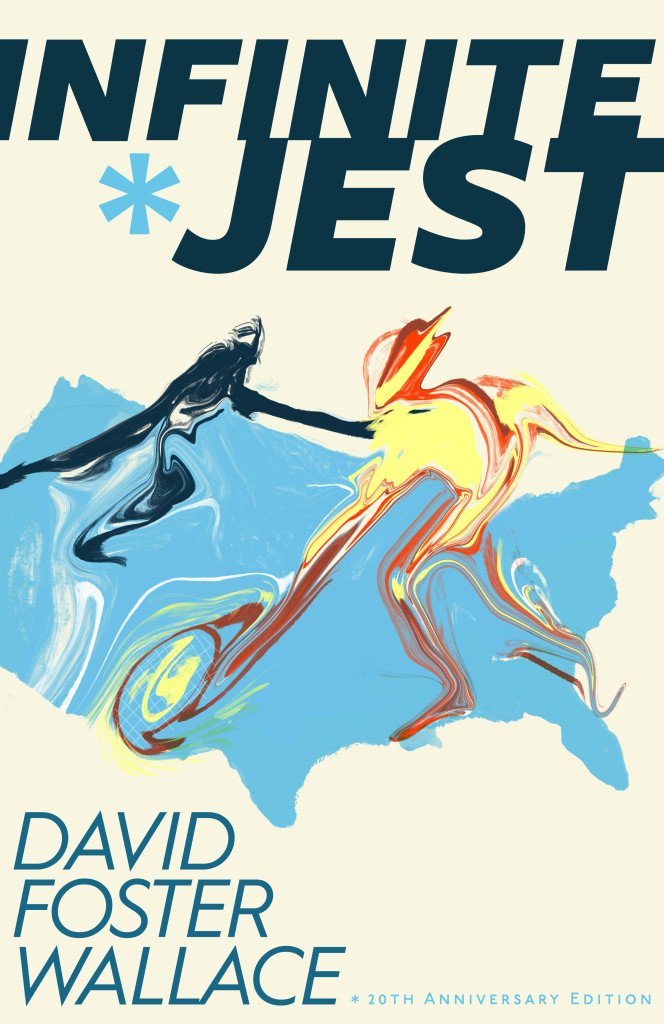
Considering our love for distance running, it feels fitting that we selected Infinite Jest as our first title for Book Club. Completing it felt like a marathon – requiring discipline and strength, as well as passion and endurance. With over 900 pages of text and 100+ pages worth of footnotes, she was not an “easy” read. However, our avid obsession for DFW made it worth the 4 lb weight.
Final Rating:
Kiva: 10/10
Pk: 9/10
Kiva
I was first introduced to David Foster Wallace through his essay E Unibus Plurum – a commentary on television-watching and U.S. Fiction. This essay was impressionable as it was read during that period of adolescence where one suddenly becomes hyper-critical of the world and its many constructs. For me, this manifested into an obsession over the ways we consume and engage with modern media. (As a result, I deleted my social media, limited my tv watching, and even purposefully shattered my phone screen – the last one *perhaps* a bit extreme.) While others called me a technophobe, Wallace’s essay offered me a manifesto of substantive ponderings over the negative effects of passive media consumption.
A few weeks later, while cleaning out a bookshelf at my home in Cambridge, I discovered an old copy of Girl With Curious Hair – a book of short stories by David Foster Wallace (one of which includes the novella Westward the Course of Empire Takes its Way, the supposed precursor to Infinite Jest). Amongst my corpus of known writers, Wallace was one who carried strong intrigue so I eagerly began this work of fiction in hopes of learning more about the author and his literary appeal.
To offer a timeline: these discoveries occurred over the grim Winter of 2020-21 amidst the depths of the COVID-19 Quarantine. Reading David Foster Wallace became my saving grace. I would escape to my bedroom, with nothing else to do on such cold, isolating evenings, and read his writings. His stories were well-worded, thought-provoking, humorous, and critical. Although fiction, they contained a level of cynical realism that captured the novelties, mundanities, and truths of the everyday world – and per his style, were always of the hyper-analytical tone. It was these initial interactions with DFW that led me to develop a love and admiration for him as a writer and as a result, the subsequent completion of many of his other works.
I have been grappling with my final thoughts regarding the completion of Infinite Jest for the past few weeks now. Unlike any other fictional novel I’ve encountered, the book felt to foster a “dynamic” relationship when reading. Perhaps this is an odd, anthropomorphic way to describe an interaction with a novel. However, I think it is these aspects which make Infinite Jest so uniquely compelling, as well as revolutionary.
There are sections of the book containing immaculate prose – articulating the human experience in such a way that one cannot put the book down. But there are also moments of brutally intense descriptions of suffering, where both the eyes and mind need a few days rest upon reading. It’s murky, intentionally, and enjoyment for the book would ebb and flow – a reiteration of the book’s theme that good entertainment is not always pure enjoyment, but sometimes requires work and effort too.
One of the hardest parts about reading IJ was having to answer the often-asked question: “What is the book about?” as there really is no easy, well-put answer. “Umm…Well… .” I would reply. “It’s about entertainment and its effects on modern, American culture.” This answer generally received blank stares which I would (attempt to) aid by adding: “It’s a sort of allegory too on addiction and its processes.” After this quick synopsis, the subject-matter would often end (or maybe “transition” is a better euphemism?) the conversation between me and whomever I was talking with.
This is all to say, Infinite Jest is a hard book to describe. Thematically more diverse and rich than anything in mainstream fiction to date, its thesis is complex and elaborate, requiring a sufficient amount (over 1000 pgs worth …) of discourse and analysis. Referred to as an “encyclopedic novel,” it is an “attempt to render the full range of knowledge and beliefs of a national culture, while identifying the ideological perspectives from which that culture shapes and interprets its knowledge.” So, a Beast.
I think why I’ve struggled with what to say regarding the end of the book is because the book was never meant to offer closure, nor promote a linear narrative. The term “novel” then feels somewhat ill-fitting for Infinite Jest. Rather, it is a pristine work of socio-political, cultural commentary. Finishing the book does not resolve the main characters’ dilemmas. Instead, it puts them in your own reality, in your society. Your eyes blink and you begin to realize all the problems written about and described are … yours. Maybe this is why finishing Infinite Jest leaves one unsettled, uneasy. Throughout its odyssey we reflect on life’s absurdities, its trials and tribulations, but at the end of it all, we want not only reassurance, but instructions – how do we fix what is described to be flawed?
The answer perhaps is not all of it can be. Fixed, that is.
For it is this particular chaos – of suffering mixed with euphoria and love, confusion and laughter, lust, joy, dissociation, and fear, comfort and anxiety, adventures and misfortunes; and even more suffering – which makes us human.
Reading Infinite Jest has made me reflect on what it means to be a human being in the 21st century. It has offered wisdom regarding postmodernism; new perspectives on sadness and its varying representations; how fucked family can be at times; how a want for escapism is not unique, but universal; how “we (who are mostly not small children) know it’s more invigorating to want than to have;”2 how we are all always trying our best; and how important are the qualities of empathy and connection.
The book, at times, made me feel like an idiot, as well as immense frustration when I just wanted to sit and watch television but had to get through the Eschaton section (if you plan to read or have read IJ, you will understand my described misery here).
But ultimately, there is some indescribable sublime quality of the book for which one cannot not appreciate it. Reading it reinforced my love for literature as an art form as Infinite Jest truly is a work of art.
Thank you David Foster Wallace for sharing your literary magic with the world. May you Rest In Peace.
- Mendelson, Edward, “Encyclopedic Narrative,” 1976. p. 1269.
- Foster Wallace, David, Infinite Jest, 1996. p. 694.
Final Notes:
- As the book is about everything, it can be an overwhelming read.
- If you do not read all the footnotes and the appendices, you will not get the book.
- He is telling multiple stories that seem entirely unrelated but which are in fact all extremely interconnected.
- There will be several moments upon reading where you will just be like: Holy Shit.
- The structure of a Book Club greatly aided the completion of Infinite Jest and I would recommend its format to whomever is choosing or wants to read it next.
Infinite Jest in different locations: (Photos forthcoming!)
 Mowgli's World
Leave a comment