

I love walking. Truly. 歩くのが大好きです。
You will often catch me touting how it is my “favorite form of transport.”
I admire its simplicity and naturalism: requiring only your own two feet, a direction, and perhaps, a pair of shoes.
It is also incredibly meditative. While walking, one receives stimuli from their outside environment, but the act of physical movement disallows negative thought loops that (at least for my brain) often occur when in a sedentary space.
If you ask me, “hiking,” really is just glorified walking. (Which is perhaps why I love both activities so much.) Although my favorite space for a walk is in nature – amongst the mountains and thickly-settled forests – there exists a different kind of magic when walking a city; “city-hiking,” as I like to call it.
Here, one can get lost in the chaos of consumerism, admire the uniqueness and variety of people, often enjoy delicious coffee, and best of all, feel like an ant – an observant wallflower amidst a waterfalling crowd.
All of this holds especially true if the city you are walking is Tokyo.
To say that Tokyo is a “unique city” is, at least for me, an understatement. It is vast and sprawling (like Los Angeles), but well connected and efficient via its advanced metro system with on-time trains arriving every five minutes. It is clean and organized, but also messy and chaotic – you won’t find a single piece of trash on the ground, and yet there are endless one-dollar souvenir shops selling individually plastic-made and plastic-wrapped Pikachu’s, and/or any other anime character. It is a city that holds both a thickly-forested park containing a Shinto shrine and Zen garden, but then, exit the the park, walk one minute, and find oneself in Shibuya: the Mecca for materialist desires.
The sacred and the secular … but a few steps away.
While walking the streets of Tokyo, there would be moments of mayhem with people surrounding you from every side, to then, walk two blocks off the main road and find yourself in sudden stillness, where all one could hear was the sound of the wind kissing the leafless trees. Another absurd polarity I witnessed was on my metro ride home where I saw an entire row of dapperly dressed, middle-aged salary-men all watching anime.
It is for these reasons that walking Tokyo felt to be a lesson in dichotomies. Although I found these seemingly endless contradictions to (for lack of a better word) clash at first. Overtime I came to find they showcased a beautiful balance. These stark transitions, oddly enough, invited the perfect amount of both chaos and calm. Realizing you cannot have one without the other — contrast is needed to identify empty space. Or however the saying goes.
Here is a link to my map and route: Walk of Tokyo Strava Post!
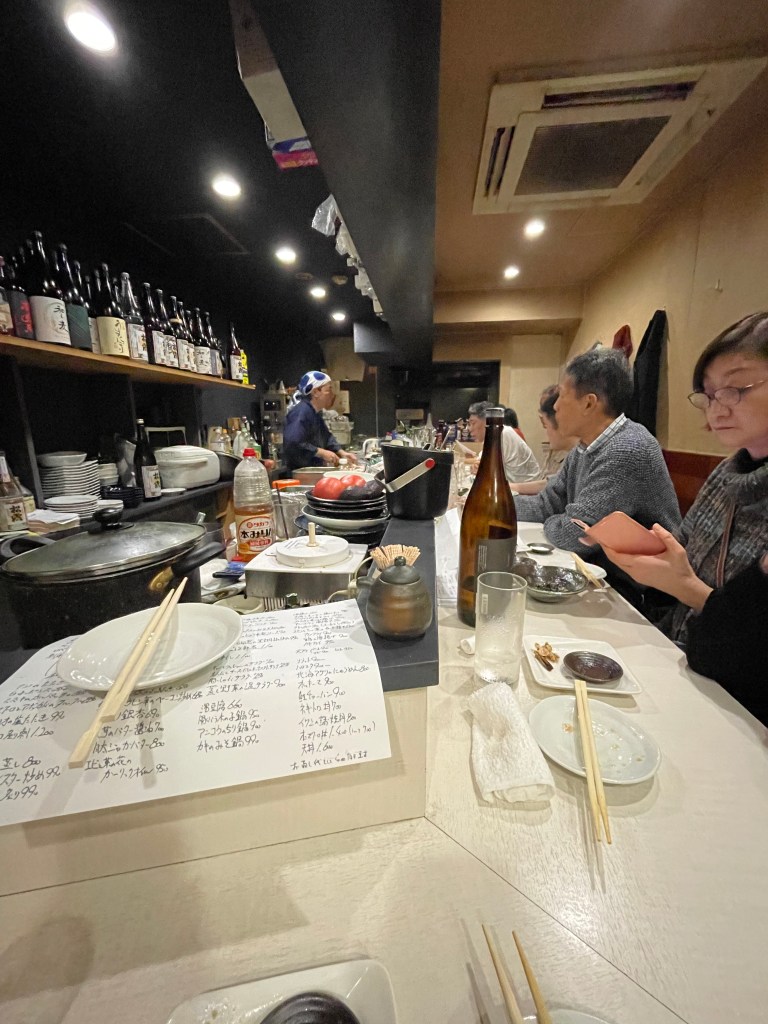
After a long day of meandering the endless streets of Tokyo, I finally took rest at a small, local Izakaya found at the corner of the street. I ordered a glass of house sake and did my best to chat with the regulars, feeling deeply satisfied and content from a day well spent, walking.


まず、ホステルを出て、コーヒーの方が思いました。でも、スマホを使いたくないでした。何をする??
Above is my brief attempt to journal in Japanese. Even if you do go through the trouble of translating it, my apologies for it doesn’t make much sense. Nonetheless, it is a good exercise for language learning.
For reference, this walk was first inspired by Haruki Murakami’s Norwegian Wood, one of my personal favorite novels. The book is a nostalgic story of loss, featuring two characters, Toru Watanabe and Naoko, who overtime build a relationship over the shared experience of their mutual friend Kizuki’s unfortunate and sudden passing.
The two characters don’t have much to talk about at first, and are unable to articulate the emotions over the death of their friend. Instead of forcing discussion, however, the characters walk, for miles, throughout the streets of Tokyo, finding solace in the shared steps, human company, and dynamic transitions in their physical environment. Their walks went, “all over Tokyo, […] climbing hills, crossing rivers and railway lines, just walking and walking with no destination in mind. We forged straight ahead,” Watanbe describes, “as if our walking were a religious ritual meant to heal our wounded spirits. If it rained, we used umbrellas, but in any case we walked” (33).
Murakami, in describing the characters perhaps unconventional interactions, so beautifully captures both the art and universal experience of walking. It’s something subtle and quiet, but transcendent. Walking can awaken the soul, open the eyes, and touch the spirit. Human’s are built for walking, and in it, there is comfort, happiness, hardship, and discovery.
Watanabe and Naoko could pursue such aimless walking too mainly in part due to the vastness of Tokyo. The city was so large, they “never could have covered it all” (33). This aspect of the book, upon initial reading, greatly fascinated me. The way the characters could “meander” for miles, and still have new pockets to discover, sparked curiosity and intrigue. I told myself that if I ever get the chance to explore Tokyo, I will take part in a Norwegian Wood inspired walk, where I walk for miles, aimlessly, without a direction, but an open and awake eye and steadfast heart.
To whomever has made it this far along in my blog post, I highly encourage you to go out walking. Get lost, and in so doing, see what you find. And also many thanks and appreciations for reading all of my thoughts and opinions on the subtle art of walking.


Murakami, Haruki and Jay Rubin. Norwegian Wood. Vintage International, 2000.
 Mowgli's World
Leave a comment